Showing posts with label Arjun MBT. Show all posts

15 March 2015

Top 10 Weapon Systems Developed by DRDO


The Defense Research and Development Organisation (DRDO) is responsible for the development of technology for use by the Indian armed forces. In recent years it has been criticized for the delayed projects and cost over runs. Because of DRDO’s poor performance in successfully delivering weapon systems and meeting timelines country fulfill its 70% of defense needs by imports from various countries.

Apart from these criticism most of which are irrational and unfair to the part of DRDO, there are many weapon systems which were largely managed by DRDO have seen considerable success with many of the systems seeing rapid deployment as well as yielding significant technological benefits. DRDO has achieved many successes since its establishment in developing other major systems and critical technologies such as aircraft avionics, UAVs, small arms, artillery systems, EW Systems, tanks and armored vehicles, sonar systems, command and control systems and missile systems.

It is very difficult to short down top 10 weapon system developed by DRDO as it has developed so many weapon systems. Based on the technological challenges, strategic importance, defense needs and level of completion of the systems these are top 10 weapon systems developed by DRDO.

========================================================================================
Top 10 Weapon Systems Developed by DRDO
========================================================================================

1. AGNI-V - Inter Continental Ballistic Missile (ICBM)


Agni-V is a inter-continental Ballistic Missile with a range more than 5000 km. Agni-V is part of the Agni series of missiles. It is a solid fuelled and can be launched from a canister Tatra Truck. So It can be launched within five minutes of threat received. It can carry a nuclear war head of 1.5 tons.

This missile is the biggest achievement of DRDO and it is very important for the nuclear deterrent and strategic posturing. Agni-V would also carry MIRV (multiple independently targetable re-entry vehicles) payloads being concurrently developed.

With this missile in armory India can Strike any part of China and Pakistan from its territory. This missile was a result of more than 30 years research in missile technology. This missile has put India in the elite club of nations who possess Inter Continental Ballistic Missiles. This missile can be used for India’s ballistic missile defense shield.

Project Status: Under Trials

2. Light Combat Aircraft - TEJAS


This is the costliest and longest going programme of DRDO. It is a 4+ generation fighter plane developed by Aeronautical Development Agency. Tejas is a lightweight multi-role jet fighter. It is a tailless, compound delta wing design powered by a single engine. It came from the LCA programme, which began in the 1980s to replace India’s aging MiG-21 fighters.

It integrates technologies such as relaxed static stability, fly-by-wire flight control system, multi-mode radar, integrated digital avionics system, composite material structures, and a flat rated engine. It is supersonic and highly maneuverable, and is the smallest and lightest in its class of contemporary combat aircraft. Navy and trainer variant of the plane has also been developed and they have received initial operational clearance.

To keep is mind the future requirements of the country, ADA is currently working on Mark-II and Mark-III of Tejas aircraft. These versions will have 5th generation features such as stealth, upgraded avionics, modified aerodynamic designs and AESA radar.

Project Status: Initial Operational Clearance is given (IOC) for production

3. INS ARIHANT - Nuclear Powered Ballistic Missile Submarine


The Arihant class is a class of nuclear-powered ballistic missile submarines being built for the Indian Navy. The lead vessel of the class, INS Arihant, was first launched in 2009 and began sea trials in December 2014. Four vessels are planned and are expected to be in commission by 2023.

The Arihant-class vessels are India’s first indigenously designed and built nuclear submarine. There are only 4-5 countries have technical capabilities to developing a nuclear powered submarines. So it’s a big technical breakthrough for the development of larger submarines in the future.

Arihant has four vertical launch tubes, which can carry twelve (three per launch tube) smaller K-15 missiles or four larger K-4 missiles. The K-4 is a longer range missile (3,500 km) and it is undergoing trials. Submarine will be fitted with USHUS sonar, developed by DRDO lab, for detecting and tracking enemy submarines, surface vessels, and torpedoes and can be used for underwater communication and avoiding obstacles.

Project Status: Under See Trials

4. RUSTOM - II - Unmanned Aerial Vehicle


Rustom is a Medium Altitude Long Endurance unmanned combat air vehicle (UCAV) being developed by Aeronautical Development Establishment in Bangalore for the three services of the Indian Armed Forces. Rustom-II is developed by India on the lines of the American Predator drones.

I will be equipped with air to surface medium range missiles to destroy enemy targets. For target acquisition and ranging it has sophisticated Medium & Long Range Electro-Optical Payloads, Laser Ranger Finders with high resolution and precision stabilized platforms.

Rustom-II is equipped with various advanced technologies and systems which includes Digital Flight Control and Navigation System, Automatic Take off and Landing, Digital communication technologies for revealing data links to control and operate the mission and relay UAVs.

Project Status: Under Trials

5. ARJUN - Main Battle Tank


The MBT Arjun is a third generation main battle tank developed by Combat Vehicles Research and Development Establishment (CVRDE), a DRDO lab in Chennai, for the Indian Army.

The Arjun features a 120 mm main rifled gun with indigenously developed Armour-piercing fin-stabilized discarding-sabot ammunition, one 7.62 mm coaxial machine gun, and a 12.7 mm machine gun. It has a four-man crew. Automatic fire detection and suppression and NBC protection systems are included. Arjun Tank is equipped with high resolution day and night vision devices which is supported by laser range finder.

The Mark-2 of Arjun has been developed which is an advanced third generation main battle tank and an upgraded version of the Arjun main battle tank with several improvements. Its development was completed in 2 years owing to experience gained from developing the first version. The top speed of the tank would be at 60 km/hr compared to 40 km/hr in Arjun mark 1. It had outclassed the T-90 during the trials. The new variant possesses superior missile firing capabilities and can fire missiles accurately up to a range of 2 km.

Project Status: Under Production

6. BRAHMOS -  Super Sonic Cruise Missile


The BrahMos has been developed as a joint venture between the Defence Research and Development Organization of India and the Federal State Unitary Enterprise of Russia under BrahMos Aerospace. The missile is named after two rivers, the Brahmaputra and the Moskva.

It is the world’s fastest cruise missile in operation. The missile travels at speeds of Mach 2.8 to 3.0. The land-launched and ship-launched versions are already in service, with the air and submarine-launched versions currently in the testing phase. An air-launched variant of BrahMos( Fitted with Su-30 MKI) is planned which is expected to come out in 2016 and will make India the only country with supersonic cruise missiles in their army, navy, and air force.

A hypersonic version of the missile namely BrahMos-II is also presently under development with speed of Mach 7 to boost aerial fast strike capability. It is expected to be ready for testing by 2017.

Like the BrahMos, the range of BrahMos II has also been limited to 290 km to comply with the MTCR. With a speed of Mach 7, it will have double the speed of the current BrahMos missile, and it will be the fastest hypersonic missile in the world.

Project Status: Under Production for all the three services

7. NIRBHAY - Medium Range Subsonic Cruise Missile


Nirbhay is a long range, subsonic cruise missile developed by the Defence Research and Development Organisation’s premier laboratory Aeronautical Development Establishment in Bangalore. Nirbhay is an all-weather low-cost long-range cruise missile with stealth and high accuracy. The missile has a range of more than 1000 km and It can be launched from a mobile launcher. It starts flying off as a rocket and then turns into an aircraft. For that it has foldable wings.

It is capable of being launched from multiple platforms on land, sea and air and shall be inducted into Indian Navy, Army, and Air Force. In particular, Nirbhay is being adapted for the Su-30MKI. The missile is capable of carrying nuclear warheads. The missile supplements Brahmos by delivering warheads farther than the 290 km range of Brahmos. This missile can fly at the height of a tree so its difficult to catch it by enemy radar.

The development of this missile is a breakthrugh for India as this missile is comparable to Pakistan’s Babur and USAs Tomhawk. It will be mounted on Su-30 MKI which will make the fighter planes more lethal.

Project Status: Under Trials

8. DHRUV - Advanced Light Helicopter


The Dhruv Helicopters have evolved from The Advanced Light Helicopter (ALH) program for an indigenous 5-ton multirole helicopter was initiated in May 1979 by the Indian Air Force and Indian Naval Air Arm. HAL were given a contract by the Indian government in 1984 to develop the helicopter.

The Dhruv has become the first major Indian weapons system to have secured large foreign sales. In 2004 HAL stated that it hoped to sell 120 Dhruvs over the next eight years, and has been displaying the Dhruv at airshows.

With a unit price at least 15 percent less than its rivals, the Dhruv has elicited interest in many countries, mostly from Latin America, Africa, West Asia, South East Asia and the Pacific Rim nations. Air forces from around 35 countries have made inquiries, along with requests for demonstrations. Flight certification for Europe and North America is also been planned in order to tap the large civilian market there.

Project Status: Under Trials

9. Ballistic Missile Defence System


Prithvi Advanced Air Defence System is for engaging the targets in the exo-atmosphere region


The Indian Ballistic Missile Defence Programme is an initiative to develop and deploy a multi-layered ballistic missile defence system to protect from ballistic missile attacks. It is a very ambitious and technology intensive project as this kind of capabilities are with only 2-3 countries in the world.

Introduced in light of the ballistic missile threat from Pakistan and China, it is a double-tiered system consisting of two interceptor missiles, namely the Prithvi Air Defence (PAD) missile for high altitude interception, and the Advanced Air Defence (AAD) Missile for lower altitude interception. The two-tiered shield should be able to intercept any incoming missile launched 5,000 kilometres away.

Advanced Air Defence System is for engaging the targets in the endo-atmosphere region

The two-tiered BMD System consists of the PAD, which will intercept missiles at exo-atmospheric altitudes of 50–80 km and the AAD missile for interception at endo-atmospheric altitudes of up to 30 km. The deployed system would consist of many launch vehicles, radars, Launch Control Centres and the Mission Control Centre. All these are geographically distributed and connected by a secure communication network.

Project Status: Under Trials

10. INSAS - Indian Small Arms System


INSAS (Indian Small Arms System) is a family of infantry arms consisting of an assault rifle and a light machine gun. It is designed by Armament Research and Development Establishment (ARDE), Pune. It is manufactured by the Ordnance Factories Board at Ordnance Factory Tiruchirappalli, Small Arms Factory Kanpur and Ichapore Arsenal.

Development of this rifle was a big achievement for the country as it replaced all the outdated rifles and their export was also stopped. INSAS has been included in the top 10 weapon systems developed by DRDO because of its mass induction in the services and export to various countries.

The assault rifle and LMG variants have been adopted by the Indian Armed Forces, Central Armed Police Forces, Indian Paramilitary Forces and police forces. On the international level India has exported a certain number of these rifles to Nepal, Bhutan and Oman. About, 300,000 units are in currently use by the Indian armed forces.

Project Status: Services are Using the rifle

6 January 2015

METAL BEHEMOTHS: The Best Battle Tanks in the World


File:Longewala Tank.jpgAs a young man, apart from worshiping exotic super cars, battle tanks were my other stellar indulgence. The 1971 Indo-Pakistan introduced me to actual tank warfare, when I got to hear about the battle of Longewala which was fought between assaulting Pakistani forces and Indian defenders at the border post of Longewala, in the Thar Desert of the Rajasthan, India. It exposed me to the fact that possessing the best tanks in the world was not good enough to win battles. The Battle was fought between India and Pakistan, in which just 120 Indian Soldiers with 1 jeep mounted M40 recoilless rifle held the fort against 2,000 invading Pakistani forces backed by 45 tanks and 1 mobile infantry brigade. Despite being so heavily out-numbered, the Indian soldiers held their ground throughout the night and with the help of the Air Force, were able to completely rout the aggressors.

The Battle of Longewala is considered by many military historians as one of the greatest field battles ever fought (including all wars until 1971) principally because the mighty odds the Indian Army confronted. This legendary valor of our armed forces held me in awe for decades right up to the recent Kargil war with Pakistan which was contrary to the battle of Longewala was fought using mainly field guns. And so I thought it was high time I wrote a piece dedicated to these awesome heavyweights, before we dwell into what the current crop has to offer let us look into a brief history of these behemoths.

BRIEF HISTORY

File:British Mark V-star Tank.jpg
British Mark V Tank

It is frequently claimed that Richard Lovell Edgeworth created a caterpillar track in 1770 which he patented as a "machine, that should carry and lay down its own road". His own account in his autobiography is of a horse-drawn wooden carriage on eight retractable legs, capable of lifting itself over high walls. The Mark V was originally invented in World War I as a means of infantry support, tanks quickly evolved over the ensuing decades to become a distinct and fearsome weapon of war.

French Renault FT-17

The Renault FT was a French light tank that was among the most revolutionary and influential tank designs in history. The FT was the first production tank to have its armament within a fully rotating turret. It had a crew compartment at the front, engine compartment at the back, and main armament in a revolving turret, which became and remains to this day the standard tank layout. Over 3,000 tanks were manufactured during the year 1918. 


German A7V

Germany fielded very few tanks during World War I, and started development only after encountering British tanks. The A7V, the only type made, was introduced in March 1918 and only 20 were produced. However, captured British Mk IVs formed the bulk of Germany's tank forces during WW I; about 35 were in service at any one time. Plans to expand the tank program were under way when the War ended.

THE TOP LIST

France: AMX Leclerc

Named in honor of General Philippe Leclerc de Hauteclocque, the General had been the commander of an Armored Division during the Second World War.

Designed during 1983, the Leclerc is in the same league as other NATO tanks and is certainly one of the top three best modern MBT’s but it is also renowned for being the most expensive tank in history. The Leclerc is all about speed. Its the lightest modern NATO tank weighting 56tons, as it has a much smaller hull and turret, giving it an added bonus of excellent Strategic mobility. It carries a SACM V8X-1500 4-stroke liquid cooled V8 diesel engine, which generates 1500hp mainly due to its Hyperbar process. It is also equipped with a computerized automatic gearbox. With its light weight, the Leclerc is one very fast machine. Unlike other MBTs of its generation, the Leclerc comes with an autoloading system which reduces the crew to three and its work burden, and has an ammo capacity of 40 rounds. Its capable of carrying 1,300 litres of diesel fuel giving it a 550km fighting range. The Leclerc has a top road speed is 72 km/h and can go up 55 km/h off road thanks to its hydrogas suspension.


India: Arjun MBT

The Arjun MBT is named after the main protagonist and world’s greatest archer from the Indian epic, "The Mahabharata". Despite the countless flak it has received during its formative phases, the Arjun today remains as one of the most potent and technologically advanced MBTs in the world, this is acknowledged by several defense analysts and technology experts across the spectrum.  Design of the tank began officially began in 2004 as a way of providing the Indian Army with an indigenously-designed and built tank main battle tank.

The Arjun sports a 120 mm main rifled gun with indigenously developed Armour-Piercing Fin-Stabilized Discarding-Sabot (APFSDS) ammunition, one 7.62 mm coaxial machine gun, and a 12.7 mm machine gun. The tanks is protected by the modular composite Kanchan armor that is composed of layers of composite alongside rolled homogenous steel, and a new honeycomb design of non-explosive and non-energetic reactive armor (NERA) is reportedly being tested as well. Kanchan is made by sandwiching composite panels between Rolled Homogenous Armor (RHA). This helps in defeating APFDS and High Explosive Anti Tank Warhead (HEAT) rounds. Trials conducted in 2000, showcased the ability of Kanchan armour to protect the tank, even when hit at point blank range by a T-72. It also demonstrated the capability to defeat HESH and APFSDS rounds, which included the Israeli APFSDS rounds. An advanced laser warning countermeasure system and a mobile camouflage system have been developed. The new advanced camouflage system will provide multi-spectral signature management, in order to protect the vehicle against all enemy sensors and smart munitions.

Like most MBTs of its generation, the Arjun has a four-man crew, including the commander, gunner, loader and a driver. It is powered by a single MTU multi-fuel diesel engine rated at 1,400 hp, and can achieve a maximum speed of 70 km/h (43 mph) and a cross-country speed of 40 km/h (25 mph). 

An extensive comparative trial was conducted by the Indian Army in March 2010, in which the Arjun was pitted against the T-90. Arjun emerged a conclusive winner from its showdown with the Russian tank and it demonstrated excellent performance under various circumstances, such as driving cross-country over rugged sand dunes, detecting, observing and quickly engaging targets, accurately hitting targets – both stationary and moving, with pin pointed accuracy. It displayed accurate and quick target acquisition capability during day and night in all types of weather and shortest possible reaction time during combat engagements. An army officer remarked that the Arjun could have performed even better, had it been operated by experienced crewmen. Nevertheless, the result was heartening vindication of DRDO technological capabilities, the Arjun MBT out-gunned and outran the T-90 on every crucial parameter.

The Arjun Mark II is an advanced third generation main battle tank and an upgraded version of the Arjun main battle tank with a total of 93 upgrades, including 13 major improvements. The Mark-II version completed most user trials in 2012 and 2013 and displayed impressive performance. The new features of the modified tank received favorable responses from defense sources.

The Arjun entered service with the Indian Army in 2004. The tanks were first inducted into the 43 Armoured Regiment, Indian Army Armoured Corps while the latest induction has been into the 75 Armoured Regiment on 12 March 2011.


Italy: C1 Ariete

The C1 Ariete is the main battle tank of the Italian Army, developed by a consortium formed by Iveco-Fiat and Oto Melara (aka CIO, Consorzio Iveco Oto Melara). The chassis and engine were produced by Iveco, while the turret and fire-control system were supplied by Oto Melara. The vehicle carries the latest optical and digital-imaging and fire-control systems, enabling it to fight day and night and to fire on the move.

It is equipped with a Oto Melara 120mm smooth-bore cannon, with thermal sleeve, a fume extractor and a muzzle reference system. It fires standard Armour Piercing Fin Stabilized Discarding Sabot (APFSDS) & High Explosive Anti Tank Warhead (HEAT) rounds and can store 42 rounds, 15 rounds in the turret and 27 in the hull. 

Mounted on the front of the tank is the BAE Systems Italia manufactured RALM laser warning receiver. The system gives the tank a 360° detection of laser guided ATM and warning. It carries the standard smoke grenade dischargers (x4 either side) on the turret. It also has a standard Chemical, biological, radiological and nuclear defense system manufactured by Sekur SpA and supported by a 7.62mm co-axially mounted machine gun, the commander has a 7.62mm machine gun mounted on his cupola, which doubles up as an anti-aircraft gun and can store 2500 rounds. The C1 uses a superior composite armor system.


UK: Challenger II

Challenger 2 is a heavily armoured, highly mobile Main Battle Tank, designed for use in the direct fire zone. Its primary role is to destroy or neutralise armour. However it has the ability to engage both hard and soft targets and can operate across a spectrum of high intensity conflict, counter insurgency and peace keeping roles. 

The vehicle is equipped with an L30 120mm rifled tank gun, firing both long rod penetrator and High Explosive Squash Head (HESH) ammunition natures. Secondary armaments are provided with a 7.62mm co-axial chain gun and a 7.62mm pintle mounted General Purpose Machine Gun.

Optical and thermal imager sights are provided for both the Commander and Gunner, including an independent 360 degree panoramic sight for the Commander. The sighting systems, turret and gun are fully stabilised enabling rapid target engagement when static and on the move. Mobility is provided through a 12-cylinder, 1,200hp Perkins CV12 diesel engine with a David Brown TN54 gearbox, providing six forward and two reverse gears. A double pin track with Hydrogas suspension and a Hydraulic Track Tensioner provide platform stability covering flat road surfaces through to rough cross country terrain.


South Korea: K2 Black Panther

The K2 Black Panther is an advanced main battle tank (MBT) featuring state-of-the-art technology developed by South Korea. It was developed to replace the various models of the aging M48 Patton tanks and complement the K1 series of MBTs currently fielded ones. 

The South Korean Army plans to deploy about 680 Black Panthers, yet the full-scale mass-production of the tank has currently been suspended due to concerns over its transmission and main engine systems. These issues may lead to a delay of service entry until March 2014. The K2 Black Panther, estimated to cost about US$8.5 million per unit, is certified as the  most expensive MBT in world by the Guinness Book of World Records.

The Black Panther is armed with a Rheinmetall 120-mm/ L55 smoothbore gun. This gun is license-produced in South Korea. This is complemented by an autoloader, similar to that designed for Leclerc, it can fire up to 15 rounds a minute. The ammunition for the main gun is loaded in a 16-shell magazine, with a total ammunition capacity of 40. The K2 is equipped with an advanced fire-control system (FCS) linked to a millimeter band radar system deployed on the frontal arc of the turret, along with a traditional laser range-finder and crosswind sensor. The system is capable of a "lock-on" mode, which can acquire and track specific targets up to a range of 9.8 km using thermal optics. This allows the crew to fire accurately while moving as well as effectively engage low-flying aircraft. The FCS is also linked to an advanced gun stabilizer and trigger-delay mechanism to optimise accuracy while moving in uneven terrain.


Germany: Leopard 2

Developed by Krauss-Maffei in the early 1970s for the West German Army, the Leopard 2 entered service in 1979 to replace the older Leopard 1 models. In addition to being the MBT of a united Germany after 1989, the Leopard 2 is also one of the most widely-used tanks in the world, serving in a total of 16 armies that range from Germany and Austria, to Canada, Turkey, Singapore and Indonesia. Due to improved technology, the tank has also gone through many variations.

The primary gun on the Leopard 2 is the Rheinmetall L/44 120 mm smoothbore gun, which is capable of firing Armour Piercing Fin Stabilized Discarding Sabot (APFSDS) warheads as well as the German DM12 multipurpose anti-tank projectile (MPAT) and the LAHAT anti-tank guided missile. It also has two 7.62mm machine guns, a coaxially-mounted one in the turret, and the other on an external anti-aircraft mount. The tank also has a stabilization system, a laser rangefinder, thermal imaging and a fire control computer.

For protection, the Leopard 2 uses spaced, multi-layered composite armor that incorporates Rolled Homogenous Armor (RHA), interior spall liners and the option of slat armor on the sides to protect from Rocket-Propelled Grenades (RPGs). The Leopard 2 is also equipped with a fire protection system that automatically dispenses halomethane foam in the event that the interior temperature rises above a certain point. It is powered by a 1,479 hp V-12 liquid-cooled twin-turbo diesel engine with a fuel capacity of 1200 liters. It has a top speed of 72 km/h (45 mph) and an operational range of 550 km (340 mi).


US: A1 Abrams

The M1A2SEP (System Enhancement Package) is the most recent and advanced version of the M1 Abrams MBTs manufactured by the United States. Weighing nearly 62 metric tons, it is one of the heaviest main battle tanks in service. The M1 Abrams, named after General Creighton Abrams, is a third-generation MBT Designed used in modern armored ground warfare. It's highly mobile, well-armed and heavily-armored. Three main variants of the M1 Abrams, namely, the M1, M1A1 and M1A2, have been deployed so far. The M1A2SEP, based on the M1A2, features a greatly enhanced armament, and advanced protection, electronics and reliability systems. A M1A2SEP costs about US$8 million.

It is capable of firing the Armour Piercing Fin Stabilized Discarding Sabot (APFSDS) and High Explosive Anti Tank warhead (HEAT) rounds, as well as the M1028 anti-personnel canister cartridge. It also comes with two 7.62mm machine guns – one coaxial and one turret-mounted – and a 12.7mm machine gun mounted by the commander’s hatch.

The tank also has a full-stabilization system for the main gun an comes equipped with a laser rangefinder, crosswind sensor, a pendulum static cant sensor, thermal imaging and a firing computer. The tank’s crew is protected by a halon firefighting system similar to the Leopard 2’s, and a rear ammo compartment with blowout panels that protect the crew from its own ammo exploding.

The tank is protected by composite armor that is composed of alloys of steel, ceramics, plastic composites, and Kevlar, similar to British Chobam & Indian Kanchan armor. It may also be fitted with reactive armor over the track skirts if needed and slat armor over the rear of the tank and rear fuel cells to protect against RPGs. Beginning in 1987, M1A1 tanks also received armor packages that incorporated depleted uranium components at the front of the turret and hull.

The M1 is powered by a 1,500 hp turbine engine which is capable of running on gas or diesel with a fuel capacity of 1,900 liters and an operational range of 426 km (265 miles). It has a top speed of 72 km/h.


10 February 2014

Is the Arjun Main Battle Tank a White Elephant?

ARJUN - MBT Mark-1
Arjun MBT has taken several years to develop as a reliable and formidable advanced armoured vehicle for the Indian Army. Experts view it as one of the best contemporary tanks in operation today. Despite this, the army due to its misplaced idiosyncrasies has been backpedalling on user/comparative user trails in the past, which forced DRDO to initiate an accelerated user trails program of their own in 2008. In June 2008, DRDO conducted stringent trails under the watchful eye of the army and had successfully completed 6000 kms of gruelling runs in Rajasthan. However, earlier results had proved that the tank had some issues with the transmission but the vendor sorted this problem and the tank performed flawlessly without failing even once during the accelerated trails in Rajasthan. The 43rd Armoured Regiment operates the Arjun tank for well over a decade now and they are completely satisfied with it. Brigadier Chandra Mukesh remarked in his report after the AURCT, “The accuracy and consistency of the Arjun has been proved beyond doubt.”

Another extensive comparative trial was conducted by the Indian Army in March 2010, in which the Arjun was pitted against the T-90. Arjun emerged a conclusive winner from its showdown with the Russian tank and it demonstrated excellent performance under various circumstances, such as driving cross-country over rugged sand dunes, detecting, observing and quickly engaging targets, accurately hitting targets – both stationary and moving, with pin pointed accuracy. It displayed accurate and quick target acquisition capability during day and night in all types of weather and shortest possible reaction time during combat engagements. An army officer remarked that the Arjun could have performed even better, had it been operated by experienced crewmen. Nevertheless, the result was heartening vindication of DRDO technological capabilities, the Arjun MBT out-gunned and outran the T-90 on every crucial parameter. Besides, the Army was constantly changing its battlefield requirements which had a direct impact on Arjun's delivery timelines.
The Kanchan class armour of Arjun is probably the best of the technologies employed which derives its name from Kanchan Bagh, Hyderabad, where the Defence Metallurgical Research Laboratory (DMRL) is located. The amour has been able to take the brunt of high precision and deadly Israeli anti tank munitions. The T-72 Ajeya and the new T-90 MBT has shown alarming vulnerability in the Georgian conflict a couple of years ago. I wonder why our Army generals are making whoopee for such sitting ducks. There is lot of money involved in importing military hardware and they are also on the lookout for those foreign jaunts and romp.


Image: Arkem8

1 February 2014

INDIA'S MIGHTY - Surprise Package


I am a subscriber to Auto India Magazine published by the renowned Business India Group. In the February 2014 issue, I was pleasantly surprised to notice an article "India's Mighty" dedicated entirely on the Indian Army's Wheeled, Tracked and Submersible vehicles. The article was absorbing and very unique in its content since it was published in a magazine solely dedicated to cars & bikes. Frankly I am not embarrassed to say that I wasn't even aware of the existence of some vehicles in the list. Please note that the article focuses entirely on the carrier vehicle rather than the weapon systems they are carrying.

Auto India is one of the oldest magazine of its kind in India, it is a cute little magazine which periodically publishes very interesting articles such as this along with its regular features, it is also the cheapest magazine among the heap published in our country (just ₹ 50/-). Unfortunately, they don't maintain an online portal, hence I am posting this for the benefit of those who follow Indian defense activities. I have taken the liberty to tweak some information & images for your benefit however, I have endeavored to maintain the general pith and the graphical layout as in the original article.

Those who are interested can subscribe the magazine here: Auto India | (Article Credit: Adreesh Ghoshal, Auto India, Feb 2014)

TANKS

The Arjun MBT is developed by DRDO and built by Central Vehicle Research and Design Establishment (CVRDE) at the Heavy Vehicles Factory at Avadi. It weighs 59 tons, and powered by a 1400bhp MTU Ka 401 turbo charged diesel engine. The Arjun has a range of 450 Km and a 120mm rifled gun. It is protected by the indigenously developed Kanchan Class explosive reactive armour, and has a top speed of 72 Kph. It can fire APFSDS, LAHAT, HE, HEAT and HESH rounds. Additionally, it is armed with a 12.7mm AA machine gun and a 7.62mm coaxial machine gun.
This Ajeya is another example of technological co-operation between India and the erstwhile USSR. The Ajeya is based on the T72M, and is armed with a new 125mm 2A46M gun. The Ajeya MKII features upgraded Polish SKO-1T DRAWA-T fire control systems and thermal imagers, laser illumination warning system, DRDO Explosive Reactive Armour, a new GPS system, improved crew protection, a new 1000bhp PZL-WOLA engine and banks of 6 smoke grenade-launchers on each side. The plan is to reequip 1,500 Ajeya's MKII with updated technology.


The T72 was perhaps the world's most advanced battle tank design when introduced in the 70’s. The T72 is extremely lightweight, at 41 tonnes, and very small compared to Western MBTs. The army used the T72 tank to ravaging effect in the 1971 war. A 780bhp V12 diesel engine powers it. It is armed with a 125mm smoothbore main gun capable of firing anti-tank guided missiles, as well as standard ammunition, including HEAT and APFSDS rounds, a 7.62mm machine gun and a 12.7mm anti-aircraft gun. It has a range of 460 km and a top speed of 60 Kph.
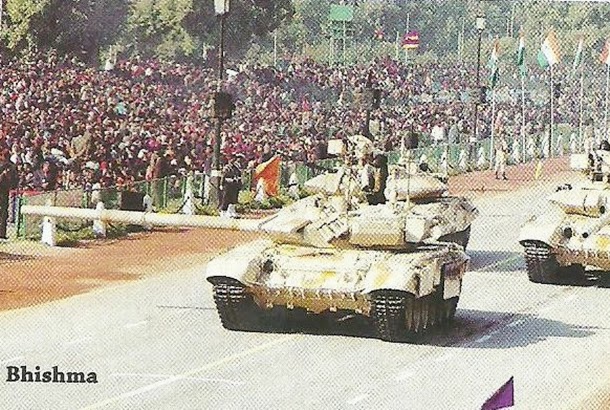
The Bhishma is the Indian version of the T90. A 1000bhp Chelyabinsk diesel engine powers it. Standard protective measures include a blend of steel, composite armour, smoke mortars, Kontakt-5 explosive-reactive armour, & laser warning receivers, Nakidka camouflage and Shtora infrared ATGM jamming system. Weighing 52-tons, it is armed with a 125mm smoothbore gun that can also fire ATGMs. The auxiliary armament consists of a 12.7mm Kord HMG and a 7.62mm pintle mounted machine gun. India operates 2011 T90 and Bhishma tanks.


ARTILLERY
The Tank-EX is a technology demonstrator that has been designed and built wholly by DRDO and CVRDE. It weighs 53 tons, and features top-secret composite armour technology. It is armed with the Arjun’s 120mm main gun, a LAHAT anti-tank guided missile tube, a 12.7mm anti-aircraft machine gun, and a 7.62mm coaxial machine gun. It has the same 1000bhp diesel engine that is used on the T72M. It has a max speed of 60kph and max range of 480Km.
The Carrier Mortar Tracked self-propelled system is based on the Sarath with also has amphibious capabilities. It has an 81mm mortar mounted on a modified troop compartment and carries totally 108 mortar rounds. It is powered by a 300bhp engine, has a maximum speed of 65kph on road, 7Kph submerged and max range of 240Km. It can be operated by all mechanized infantry battalions providing instantaneous fire support, and also provide protection to the crew.
The Bhim self-propelled howitzer and is designed as a purpose built self-propelled artillery vehicle. Weighing 60 tons, it has a firing range of 52Km. It has a 14.5mm welded steel armour, and is armed with a Denel 155mm L52GS howitzer. It can carry 50 rounds and is powered by a 1400bhp Ka-501 engine that gives it a top speed of 60Kph and a max range of 450Km. It has a fully automatic ammunition loading system, as well as a turret-mounted auxiliary power unit.
The Pinaka is a Multiple Barrel Rocket Launcher (MBRL) artillery system. Each launcher consists of 12 rockets and can be operated in manual, automatic tergetting or remote controlled mode. The rockets have a range of 60Km. Pinaka saw service during the Kargil War, where it was successful in neutralizing enemy positions on the mountain tops. The launcher is mounted on a Tatra Kolos truck, it has a maximum combat range of 120Km and a maximum speed of 80Kph.

INFANTRY COMBAT VEHICLES/APC
The BM-30 Smerch (Russian for Tornado) is the precursor to Pinaka MBRL. It entered service in the Soviet Army in 1989. After the collapse of the Soviet Union, a number of these MBRL’s were sold to India. A 525bhp 12-cylinder diesel engine powers it, due to which it has a top speed of 60Kph and a maximum range of 850Km. The 300mm rockets have a range of 90Km.
The Sarath (Chariot of Victory) is a second-generation, amphibious infantry-fighting vehicle and Armoured Personnel Carrier developed and manufactured by the Ordinance Factory, Medak. A 300bhp UTD3 diesel engine powers the vehicle. It is armed with a 300mm canon and a Konkurs anti-tank guided missile. It has a maximum speed of 65kph on road and 7Kph submerged.
The Abhay Infantry Fighting Vehicle (IFV) developed by DRDO and CVRDE weighs 23 tons and is manned by a crew of 3, and can carry 7 fully armed soldiers. It is armed with a 40mm Bofors automatic cannon, a 30mm automatic grenade launcher, a 7.62mm machine gun, and two anti-tank guided missile tubes. The Abhay is powered by a Greaves-Cotton TD2V8 diesel engine. It has a combat range of 400Km and maximum speed of 70Kph on road and 35Kph off-road.
The Cassapir has been specifically designed for anti-mine operations  as well as protection from small arms fire. It can absorb explosive energy equivalent of up to 100kg of TNT. It weighs 10.80 tons, and is powered by a 166bhp Atlantis OM352A turbo charged diesel engine. This 4X4 armoured personnel carrier has an operational range of 770Km, and is armed with three 7.62mm machine guns or a 20mm cannon. It can carry 14 soldiers.
The BMD-2 is an airborne infantry fighting vehicle, meaning it can be airdropped along with paratroopers. A 241bhp 5D-20 1598cc 5-cylinder diesel engine powers it. It is armed with a 30mm 2A42 multipurpose auto cannon, a anti tank guided missile tube and twin 7.62mm machine guns. It has a range of 450Km and can travel at 80Kph on road and 10Kph submerged.
This British built FV432 is one of the lightest and fastest Armoured Personnel Carrier in the Indian Army. It is an all-steel construction and weighs 15 tons and powered by a 240bhp Rolls-Royce K60 multi-fuel engine. The FV432 has a maximum speed of 52Kph and a maximum range of 580Km. It is powered by a 12.7mm machine gun and a 7.62 light machine gun (LMG).
The DRDO LAWV (Light Armoured Wheeled Vehicle) is a lightweight 4X4 armoured combat vehicle that is based on the Canadian LAVIII and the Swiss Piranha III 8X8. It has a 160bhp diesel engine thst gives it a top speed of 84Kph and a maximum range of 500Km. Its main weapon is the 7.62mm light machine gun (LMG).
The T62 Topas is jointly built by the former Czechoslovakia and Poland, the TOPAS is a tracked amphibious armoured personnel carrier. It is powered by a 300bhp 6-cylinder PV-6 diesel engine. It has a top speed of 60Kph on road and 10.8Kph submerged. It is armed with a 12.7mm machine gun, grenade launchers and a 7.62mm LMG.
The SKOT is an upgraded version of the TOPAS. It is powered by a 180bhp Tatra diesel V8 that gives it a top speed of 96Kph and a range of 710Km. It is armed with a 14.5mm PKV machine gun and 7.62 PKT machine gun. It can carry up to 18 Soldiers.
The BTR 152 was the first Soviet armoured vehicle produced specifically for export after World War II. It is powered by 110bhp petrol engine, has a top speed of 75Kph and a maximum range of 650 Km, and armed with twin 7.6 mm machine gun.

SUPPORT VEHICLES
The SISU NASU (tracked piglet in Finnish), is a tracked articulated, all-terrain transport vehicle. It has a driver cab and a separate cargo wagon, similar to the ones used in a train. It is powered by a 152bhp 6.2 litre GM V8. It consists of 2 units, with all four tracks powered and it can carry up to 17 people.
The Akash Surface to Air Missile (SAM) is one of the most sophisticated missiles in the world. The entire radar and targeting systems is mounted on a T72 chassis. The Launcher can also be detached and towed by a Ashok Leyland Stallion truck, in case the T72 breaks down.
The NAMICA (Nag Missile Carrier) is a tank destroyer built on a Sarath chassis. The NAMICA weighs 14.5 tons and can carry 14 missiles. The Nag missile is slated to replace all foreign anti-tank missiles in the Army. It can travel at up to 50Kph on road and 7Kph submerged.
The BT55/MT55KS is a Soviet built T55 tank that has been adapted to lay bridges over difficult terrain. The bridge system is controlled hydraulically and has a maximum load of 60 tons. The BT55 is powered by a 600bhp V12 diesel engine, has a maximum range of 580Km and can travel at 50Kph.
The AERV (Armoured Engineer Reconnaissance Vehicle), is based on the T55 and the Vijyanta tanks. It was designed by DRDO and is manufactured by Ordinance Factory Medak. The AERV is used for spotting suitable locations to set up artillery posts, base camps and bridges.
The FV180 Combat Engineering Tractor is a British built amphibious vehicle use, used for towing tanks, artillery and constructin work. It weighs 17 tons, and is powered by a 320bhp Rolls-Royce C6TFR engine. It has a range of 480Km and a maximum speed of 55Kph on road and 15Kph submerged.
The WZT is an armoured recovery vehicle based on the T72M. The WZT-3M has a 850 hp PZL-Wola S12U 4-cylinder 38.9 litre diesel from PT-91 that gives it a maximum range of 450Km and a maximum speed of 60Kph. India operates 556 WZT2 -3 vehicles and are now being licence-produced by BEML.
DRDO worked on the Sarath IFV chassis to create the Armoured Ambulance vehicle. It has an inbuilt electrocardiogram unit (ECG), a ventilator, a suction unit, a direct current refrigerator to store medicines and drugs and a high capacity heating, ventilation, and air conditioning (HVAC) system.
The Hydrema (“Mine Munching Monster") consists of a flail that rotates at high speed in order to deflect mines. The blast force is deflected outwards by means of a thick metal deflector plate. It is powered by a 6-litre V6 diesel engine that is rated at 185bhp. It has a maximum speed of 42Kph. It has foam filled tires to protect them from fragmentation.
The Polish built multiple axle transport vehicle Kolos is one of the most important vehicles in the Indian Army. The 1764cc V12 diesel engine is rated at 266bhp and is multi-fuel capable. The chassis can be adapted to fit 6 or 8 wheel drive, depending on the requirements. It is used as a transporter-erector-launcher for the Agni, Prithvi, Prahaar and Brahmos missiles.