Showing posts with label Akash. Show all posts

25 December 2014

DRDO looks back on Year 2014


DRDO Tests Glide Bomb Successfully

December, 2014


A 1,000-kg glide bomb designed and developed by the Defence Research and Development Organisation (DRDO) was successfully tested in the Bay of Bengal off the Odisha coast. The bomb was dropped by an Indian Air Force aircraft.

Defence sources said the bomb, guided by its onboard navigation system, glided for nearly 100 km before hitting the target with precision. Its flight was monitored by radars and electro-optic systems stationed at the Chandipur-Based Integrated Test Range.

9 May 2014

India's Missile Armory


INTRODUCTION

If we naive Indians have to aver the barb of Mr. Gary Milhollin who doesn't fail to incessantly purport ad nausea in various fora across the US in the hope that we would sublimely come to believe that the American military and space program has been a squeaky clean effort. Pitifully and regrettably it is not so. He jibes that the Indian civilian space and later military programs have been offshoots of generous help rendered by the western space powers, especially the US, Germany and France. However, what he his figuratively trying to convey is rhetorical, deceptive and discriminating in its agenda. Agreed, India may have taken some technical aid from other nations to develop its nascent civilian space program, but discounting India's genuine effort thereafter to develop technology is certainly selective amnesia. Interestingly, America did not develop its space or military ballistic missile programs on its own, it however leapfrogged to acquire high technology solutions in space and defense by resorting to ignominious means.

PROOF IN THE PUDDING

Modern rocketry started with the ambitions of an obnoxious and direful psychopath who wanted to dominate the world. His name - Hitler. He wanted to possess a super weapon to quash the allied countries. The man who would help Hitler realize this dream was a Nazi rocket scientist named Wernher Magnus Maximilian von Braun or commonly known as Wernher von Braun, an avid Nazi sympathizer. He developed the V-2 or Aggregat-4 long-range ballistic missile perhaps one of the greatest technological achievements of this century. After the fall of the “Third Reich”, American soldiers captured von Braun and some of his key associates, and the prized catch was clandestinely shipped to America. The Americans brought over 300 trainloads of spare V-2 parts to the United States from Nazi Germany. Much of von Braun's production team was also captured by the Soviets. Wernher von Braun and his compatriots war careers as Nazis was deceitfully hidden from the public by the US government. In White Sands, New Mexico, von Braun and his team trained and tested rockets for the US military and for several years went about launching captured V-2 rockets. Before 1945, neither the Americans nor the Soviets had any extensive advanced rocket facilities or programs and it was von Braun and his team who were instrumental in developing this capability. Hence, the early American rocket program development is steeped in so much muck that even the Americans would want to forget and disown it. This could be the very reason why Mr. Milhollin fails to mention this fact even as a supplementary note in his speeches on the subject of proliferation.

India has a very solid non-proliferation record unlike China or Pakistan in the region as its institutions are bound by solid democratic principles governed by rule of law and its decision makers have complete legislative power over these entities. India has been a very responsible and stable nuclear power right from its inception and until this day. The authors' contention and concern on the risk that cooperating with India (this was way back in the 1990's) could contribute to the spread of missile technology was rather unfounded. On the other hand, when Pakistan illegally started developing its atom bomb in response to India's own nuclear weapon status, by either stealing, smuggling or rummaging the international market for machinery, parts and components, the Americans conveniently turned the proverbial blind eye thus encouraging Pakistan to develop what is now known as the "Islamic Bomb". This was permitted by the US in the name of its National Interest policy. Other intervention policies like the support to the Afghan Mujaheddin has backfired with severe ramifications which eventually led to the 9/11 massacre of several thousand innocent Americans. On the question of China, these guys supplied Pakistan with sophisticated gas centrifuges to enrich uranium and in turn, Pakistan sold this technology to Iran and Libya via the A Q Khan network in the name of “Islamic Brotherhood”. The US did not take Pakistan to task then, when A Q Khan openly sold other nuclear technology secrets to the so-called “Rouge State” North Korea, all it did was to impose punitive sanctions, which the Pakistanis cared less. Pakistan continued trading in illegal weapons despite these sanctions since it was aware that the US would not alter its "friendly" relationship with it because of the ongoing war against the Taliban in Afghanistan. The US is dependent on Pakistan for logistics support.
Pakistani weapons trade with North Korea is rather amusing since the technology exchange followed was a sort of archaic barter system; Pakistan got critical ballistic missile technology from North Korea in exchange for Pakistan’s nuclear know-how.
The Americans have failed to realize that they are bound to face an impending nuclear attack not from India, Russia, China, North Korea or even Iran but sure as shooting from Pakistan. Realizing rather late US and its cohorts are hastening ways and means to secure Pakistan’s dirty bombs, especially given Pakistan’s vacillation between being ruled by a trigger happy military junta and the fair chance of being overrun by religious zealots who by all means will not hesitate to use these nuclear assets against India, Israel and the US.
Hence, it is imperative that India develops and maintains a minimum qualitative and quantitative credible nuclear deterrence and defense program in whatsoever manner against its adversaries, taking into account its long term strategic and security requirements as a responsible emerging global power.
(Gary Milhollin-Professor, University of Wisconsin Law School and Director, Wisconsin Project on Nuclear Arms Control in a discourse before the House Committee on Science, June 25, 1998)

PROJECT "DEVIL" & "VALIANT"

India’s quest to develop a short-range ballistic missile started way back in the 1970’s when the Project “Devil” and Project “Valiant” were conceived. These projects were the precursor of the more transparent and successful Integrated Guided Missile Development Program (IGMDP) conceived by former President of India Dr. A P J Abdul Kalam, which was launched in 1983. It is generally believed that the Defense Research and Development Laboratory (DRDL), which had begun in 1958 and later, transpired into what is now DRDO intended to reverse engineer the Soviet Union’s S-75 Dvina ballistic missile. This is not the case, as India never had the policy to either reverse engineer nor adopt crafty branding techniques of bought out weapons as being done by other nations to bolster its offensive aspirations. Project “Valiant” died an early death and Project “Devil” continued with secretive government funding and support. The project was a partial success, however plenty of new technologies, design competence, materials and components development and production techniques were realized during its development, which laid ground for the more successful Prithvi and Akash programs.

Though there are several imported missiles in the armed forces, I have however focused exclusively on the systems developed indigenously.

The task to develop several technologies was difficult for the Indian scientists as they did not have prior expertise, industrial infrastructure nor the production efficiency to develop high-tech machinery, components, subsystems and products. But with customary resolve they solved daunting problems successively and developed truly world class products for the armed forces. Over the past decade development of critical technologies has been accomplished on a trial and error basis, similar to the proven model of repetitive testing adopted by the erstwhile Soviet space and defense scientists to prove the efficacy of new technologies. Therefore, delivery schedules of some final products has suffered to reach the end-users on time and as a result DRDO and its related agencies have invited considerable flak. However, in most of the cases the rebukes are rather unmindful, unfair and unjustified.

_____________________________________________________________

SHORT RANGE BALLISTIC MISSILES


Images: DRDO

PRITHVI-I

Prithvi-I "Earth" in Sanskrit is a theater class short-range, road-mobile, liquid-propelled ballistic missile with two motors clustered next to each other as a single stage configuration. Prithvi was the first missile to be developed under the IGMDP. It has a warhead mounting capability of 1,000 kg and a range of 150 km. It has an accuracy of 10 – 50 meters and can be launched from a transporter erector launcher. It was inducted into the Indian Army in 1994. This missile will be phased out once the more capable and accurate Prahar missile completes its development process. The Prithvi-I will be later upgraded and used for longer ranges.

1 February 2014

INDIA'S MIGHTY - Surprise Package


I am a subscriber to Auto India Magazine published by the renowned Business India Group. In the February 2014 issue, I was pleasantly surprised to notice an article "India's Mighty" dedicated entirely on the Indian Army's Wheeled, Tracked and Submersible vehicles. The article was absorbing and very unique in its content since it was published in a magazine solely dedicated to cars & bikes. Frankly I am not embarrassed to say that I wasn't even aware of the existence of some vehicles in the list. Please note that the article focuses entirely on the carrier vehicle rather than the weapon systems they are carrying.

Auto India is one of the oldest magazine of its kind in India, it is a cute little magazine which periodically publishes very interesting articles such as this along with its regular features, it is also the cheapest magazine among the heap published in our country (just ₹ 50/-). Unfortunately, they don't maintain an online portal, hence I am posting this for the benefit of those who follow Indian defense activities. I have taken the liberty to tweak some information & images for your benefit however, I have endeavored to maintain the general pith and the graphical layout as in the original article.

Those who are interested can subscribe the magazine here: Auto India | (Article Credit: Adreesh Ghoshal, Auto India, Feb 2014)

TANKS

The Arjun MBT is developed by DRDO and built by Central Vehicle Research and Design Establishment (CVRDE) at the Heavy Vehicles Factory at Avadi. It weighs 59 tons, and powered by a 1400bhp MTU Ka 401 turbo charged diesel engine. The Arjun has a range of 450 Km and a 120mm rifled gun. It is protected by the indigenously developed Kanchan Class explosive reactive armour, and has a top speed of 72 Kph. It can fire APFSDS, LAHAT, HE, HEAT and HESH rounds. Additionally, it is armed with a 12.7mm AA machine gun and a 7.62mm coaxial machine gun.
This Ajeya is another example of technological co-operation between India and the erstwhile USSR. The Ajeya is based on the T72M, and is armed with a new 125mm 2A46M gun. The Ajeya MKII features upgraded Polish SKO-1T DRAWA-T fire control systems and thermal imagers, laser illumination warning system, DRDO Explosive Reactive Armour, a new GPS system, improved crew protection, a new 1000bhp PZL-WOLA engine and banks of 6 smoke grenade-launchers on each side. The plan is to reequip 1,500 Ajeya's MKII with updated technology.


The T72 was perhaps the world's most advanced battle tank design when introduced in the 70’s. The T72 is extremely lightweight, at 41 tonnes, and very small compared to Western MBTs. The army used the T72 tank to ravaging effect in the 1971 war. A 780bhp V12 diesel engine powers it. It is armed with a 125mm smoothbore main gun capable of firing anti-tank guided missiles, as well as standard ammunition, including HEAT and APFSDS rounds, a 7.62mm machine gun and a 12.7mm anti-aircraft gun. It has a range of 460 km and a top speed of 60 Kph.
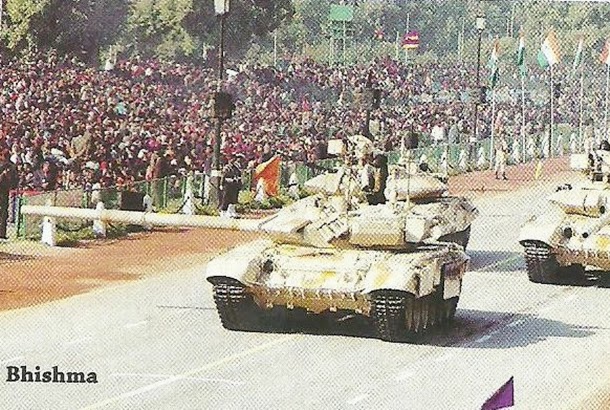
The Bhishma is the Indian version of the T90. A 1000bhp Chelyabinsk diesel engine powers it. Standard protective measures include a blend of steel, composite armour, smoke mortars, Kontakt-5 explosive-reactive armour, & laser warning receivers, Nakidka camouflage and Shtora infrared ATGM jamming system. Weighing 52-tons, it is armed with a 125mm smoothbore gun that can also fire ATGMs. The auxiliary armament consists of a 12.7mm Kord HMG and a 7.62mm pintle mounted machine gun. India operates 2011 T90 and Bhishma tanks.


ARTILLERY
The Tank-EX is a technology demonstrator that has been designed and built wholly by DRDO and CVRDE. It weighs 53 tons, and features top-secret composite armour technology. It is armed with the Arjun’s 120mm main gun, a LAHAT anti-tank guided missile tube, a 12.7mm anti-aircraft machine gun, and a 7.62mm coaxial machine gun. It has the same 1000bhp diesel engine that is used on the T72M. It has a max speed of 60kph and max range of 480Km.
The Carrier Mortar Tracked self-propelled system is based on the Sarath with also has amphibious capabilities. It has an 81mm mortar mounted on a modified troop compartment and carries totally 108 mortar rounds. It is powered by a 300bhp engine, has a maximum speed of 65kph on road, 7Kph submerged and max range of 240Km. It can be operated by all mechanized infantry battalions providing instantaneous fire support, and also provide protection to the crew.
The Bhim self-propelled howitzer and is designed as a purpose built self-propelled artillery vehicle. Weighing 60 tons, it has a firing range of 52Km. It has a 14.5mm welded steel armour, and is armed with a Denel 155mm L52GS howitzer. It can carry 50 rounds and is powered by a 1400bhp Ka-501 engine that gives it a top speed of 60Kph and a max range of 450Km. It has a fully automatic ammunition loading system, as well as a turret-mounted auxiliary power unit.
The Pinaka is a Multiple Barrel Rocket Launcher (MBRL) artillery system. Each launcher consists of 12 rockets and can be operated in manual, automatic tergetting or remote controlled mode. The rockets have a range of 60Km. Pinaka saw service during the Kargil War, where it was successful in neutralizing enemy positions on the mountain tops. The launcher is mounted on a Tatra Kolos truck, it has a maximum combat range of 120Km and a maximum speed of 80Kph.

INFANTRY COMBAT VEHICLES/APC
The BM-30 Smerch (Russian for Tornado) is the precursor to Pinaka MBRL. It entered service in the Soviet Army in 1989. After the collapse of the Soviet Union, a number of these MBRL’s were sold to India. A 525bhp 12-cylinder diesel engine powers it, due to which it has a top speed of 60Kph and a maximum range of 850Km. The 300mm rockets have a range of 90Km.
The Sarath (Chariot of Victory) is a second-generation, amphibious infantry-fighting vehicle and Armoured Personnel Carrier developed and manufactured by the Ordinance Factory, Medak. A 300bhp UTD3 diesel engine powers the vehicle. It is armed with a 300mm canon and a Konkurs anti-tank guided missile. It has a maximum speed of 65kph on road and 7Kph submerged.
The Abhay Infantry Fighting Vehicle (IFV) developed by DRDO and CVRDE weighs 23 tons and is manned by a crew of 3, and can carry 7 fully armed soldiers. It is armed with a 40mm Bofors automatic cannon, a 30mm automatic grenade launcher, a 7.62mm machine gun, and two anti-tank guided missile tubes. The Abhay is powered by a Greaves-Cotton TD2V8 diesel engine. It has a combat range of 400Km and maximum speed of 70Kph on road and 35Kph off-road.
The Cassapir has been specifically designed for anti-mine operations  as well as protection from small arms fire. It can absorb explosive energy equivalent of up to 100kg of TNT. It weighs 10.80 tons, and is powered by a 166bhp Atlantis OM352A turbo charged diesel engine. This 4X4 armoured personnel carrier has an operational range of 770Km, and is armed with three 7.62mm machine guns or a 20mm cannon. It can carry 14 soldiers.
The BMD-2 is an airborne infantry fighting vehicle, meaning it can be airdropped along with paratroopers. A 241bhp 5D-20 1598cc 5-cylinder diesel engine powers it. It is armed with a 30mm 2A42 multipurpose auto cannon, a anti tank guided missile tube and twin 7.62mm machine guns. It has a range of 450Km and can travel at 80Kph on road and 10Kph submerged.
This British built FV432 is one of the lightest and fastest Armoured Personnel Carrier in the Indian Army. It is an all-steel construction and weighs 15 tons and powered by a 240bhp Rolls-Royce K60 multi-fuel engine. The FV432 has a maximum speed of 52Kph and a maximum range of 580Km. It is powered by a 12.7mm machine gun and a 7.62 light machine gun (LMG).
The DRDO LAWV (Light Armoured Wheeled Vehicle) is a lightweight 4X4 armoured combat vehicle that is based on the Canadian LAVIII and the Swiss Piranha III 8X8. It has a 160bhp diesel engine thst gives it a top speed of 84Kph and a maximum range of 500Km. Its main weapon is the 7.62mm light machine gun (LMG).
The T62 Topas is jointly built by the former Czechoslovakia and Poland, the TOPAS is a tracked amphibious armoured personnel carrier. It is powered by a 300bhp 6-cylinder PV-6 diesel engine. It has a top speed of 60Kph on road and 10.8Kph submerged. It is armed with a 12.7mm machine gun, grenade launchers and a 7.62mm LMG.
The SKOT is an upgraded version of the TOPAS. It is powered by a 180bhp Tatra diesel V8 that gives it a top speed of 96Kph and a range of 710Km. It is armed with a 14.5mm PKV machine gun and 7.62 PKT machine gun. It can carry up to 18 Soldiers.
The BTR 152 was the first Soviet armoured vehicle produced specifically for export after World War II. It is powered by 110bhp petrol engine, has a top speed of 75Kph and a maximum range of 650 Km, and armed with twin 7.6 mm machine gun.

SUPPORT VEHICLES
The SISU NASU (tracked piglet in Finnish), is a tracked articulated, all-terrain transport vehicle. It has a driver cab and a separate cargo wagon, similar to the ones used in a train. It is powered by a 152bhp 6.2 litre GM V8. It consists of 2 units, with all four tracks powered and it can carry up to 17 people.
The Akash Surface to Air Missile (SAM) is one of the most sophisticated missiles in the world. The entire radar and targeting systems is mounted on a T72 chassis. The Launcher can also be detached and towed by a Ashok Leyland Stallion truck, in case the T72 breaks down.
The NAMICA (Nag Missile Carrier) is a tank destroyer built on a Sarath chassis. The NAMICA weighs 14.5 tons and can carry 14 missiles. The Nag missile is slated to replace all foreign anti-tank missiles in the Army. It can travel at up to 50Kph on road and 7Kph submerged.
The BT55/MT55KS is a Soviet built T55 tank that has been adapted to lay bridges over difficult terrain. The bridge system is controlled hydraulically and has a maximum load of 60 tons. The BT55 is powered by a 600bhp V12 diesel engine, has a maximum range of 580Km and can travel at 50Kph.
The AERV (Armoured Engineer Reconnaissance Vehicle), is based on the T55 and the Vijyanta tanks. It was designed by DRDO and is manufactured by Ordinance Factory Medak. The AERV is used for spotting suitable locations to set up artillery posts, base camps and bridges.
The FV180 Combat Engineering Tractor is a British built amphibious vehicle use, used for towing tanks, artillery and constructin work. It weighs 17 tons, and is powered by a 320bhp Rolls-Royce C6TFR engine. It has a range of 480Km and a maximum speed of 55Kph on road and 15Kph submerged.
The WZT is an armoured recovery vehicle based on the T72M. The WZT-3M has a 850 hp PZL-Wola S12U 4-cylinder 38.9 litre diesel from PT-91 that gives it a maximum range of 450Km and a maximum speed of 60Kph. India operates 556 WZT2 -3 vehicles and are now being licence-produced by BEML.
DRDO worked on the Sarath IFV chassis to create the Armoured Ambulance vehicle. It has an inbuilt electrocardiogram unit (ECG), a ventilator, a suction unit, a direct current refrigerator to store medicines and drugs and a high capacity heating, ventilation, and air conditioning (HVAC) system.
The Hydrema (“Mine Munching Monster") consists of a flail that rotates at high speed in order to deflect mines. The blast force is deflected outwards by means of a thick metal deflector plate. It is powered by a 6-litre V6 diesel engine that is rated at 185bhp. It has a maximum speed of 42Kph. It has foam filled tires to protect them from fragmentation.
The Polish built multiple axle transport vehicle Kolos is one of the most important vehicles in the Indian Army. The 1764cc V12 diesel engine is rated at 266bhp and is multi-fuel capable. The chassis can be adapted to fit 6 or 8 wheel drive, depending on the requirements. It is used as a transporter-erector-launcher for the Agni, Prithvi, Prahaar and Brahmos missiles.